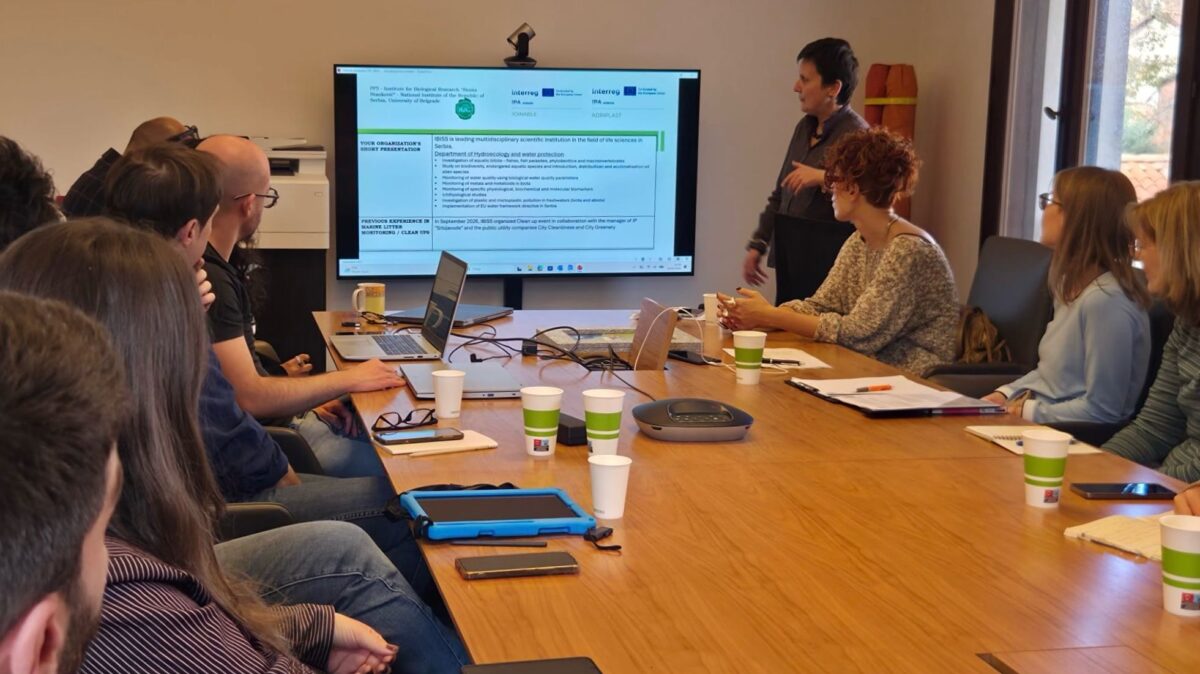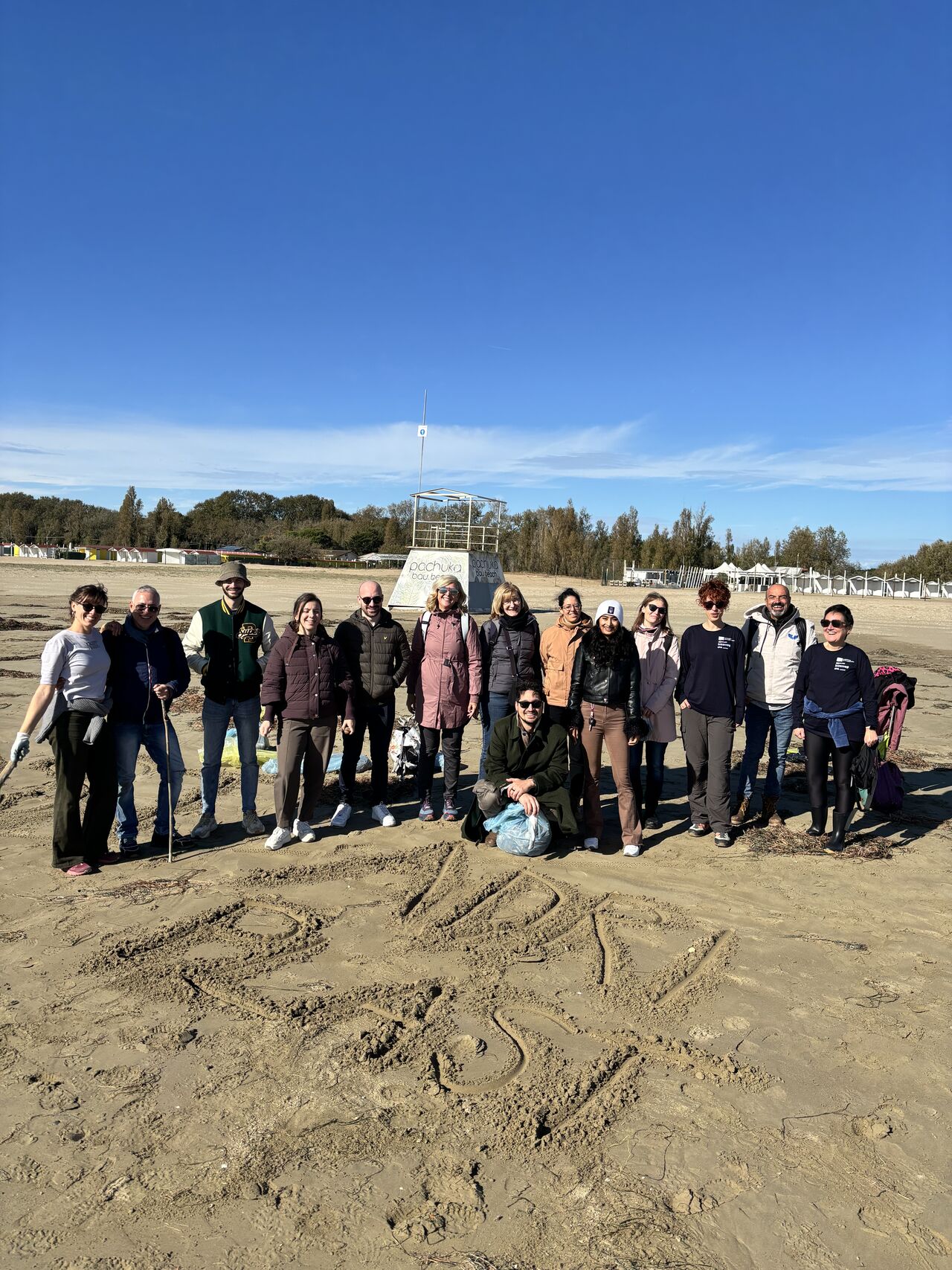
On 22 and 23 October 2026, Venice Lagoon Plastic Free (VLPF) welcomed partners from across the Adriatic-Ionian region to Venice for two days of training on how to monitor and clean up litter on beaches. The workshop took place at VLPF’s new multifunctional headquarters, the former Herion depot in Campo San Cosmo on Giudecca Island, and ended with fieldwork on San Nicolò beach on the Lido.
The workshop brought together two projects co-funded by the European Union under the Interreg IPA ADRION programme, JOINABLE and ADRIPLAST, both of which tackle marine litter in the Adriatic-Ionian region. It was organised in cooperation with the Department of Environmental and Prevention Sciences (DiSAP) of the University of Ferrara (UNIFE), which coordinated the participants. Participants came from CURSA (University Consortium for Socio-Economic and Environmental Research) in Italy, the Institute of Public Health of Montenegro, the Ruđer Bošković Institute in Croatia, the National Institute of Biology in Slovenia, and the Institute for Biological Research “Siniša Stanković” in Serbia.
The idea behind the event is simple. Marine litter moves freely across borders, so organisations in different countries need to measure it in the same way, for the data to be comparable and for policymakers to act on standardised European data. The workshop set out to build this common approach, and participants arrived in Venice on 21 October each bringing experience from their own demo site.
The first day opened with a round of introductions, which gave each partner the chance to present their work. The focus then turned to two apps developed by VLPF. Participants tried out Shoreline Monitor, an app for recording the litter found on a beach, which now also covers microplastics (fragments smaller than 5 mm) and mesoplastics (slightly larger pieces) thanks to work with UNIFE. They also learned about SeaClear2.0 Mare Pulito, an app that supports cleanup activities, through a short presentation.
The afternoon moved on to methodology, with sessions on the do’s and don’ts of cleanups and beach litter monitoring, the sampling of microplastics and mesoplastics, and the use of drones for surveys of larger litter. These approaches work at opposite scales. Microplastics are hard to see, so a careful and standard sampling method is essential to obtain reliable data. Drones, on the other hand, can map litter along a long stretch of coastline in a single flight, much faster than a survey on foot. A final briefing prepared the group for the day ahead.
On the second day, participants moved from VLPF’s headquarters to San Nicolò beach to put the training into practice. They carried out marine litter monitoring with the Shoreline Monitor app presented the day before. The workshop closed with an evaluation test.
The results of the fieldwork and the experience gathered over the two days will now feed into the work of JOINABLE and ADRIPLAST across the region. The partners involved agreed to share their main results and achievements in the frame of the 7th International Workshop on Marine Litter Monitoring, Removal and Blue Circular Economy. VLPF thanks all the partners who travelled to Venice and the University of Ferrara for their collaboration. To find out more about the outcomes of the workshop, follow VLPF and the JOINABLE LinkedIn page.